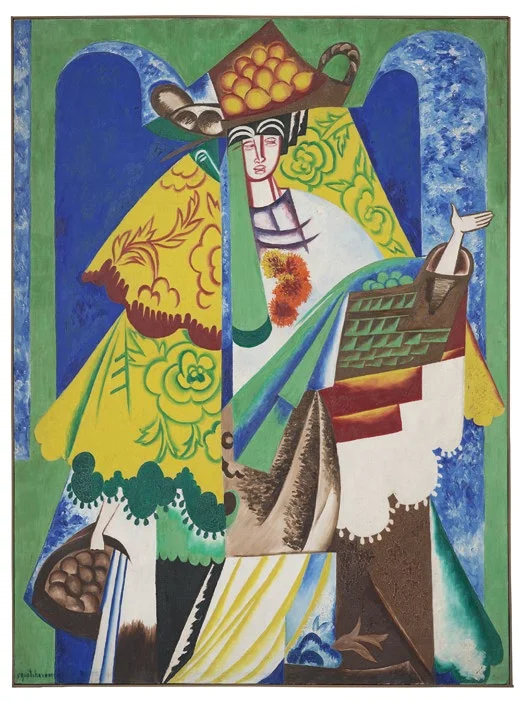
For over a decade, the Museum Ludwig in Cologne has undertaken one of the most rigorous and transparent forensic investigations in modern museum history. The project, titled “Russian Avant-Garde at the Museum Ludwig: Original and Fake,” was launched to systematically evaluate the authenticity of its extensive collection of early 20th-century Russian modernism.
This specific field of art history has long been described by experts as “the most forgery-riddled field,” a status exacerbated by the unique historical and geopolitical circumstances surrounding the movement. The radical experimentation of the Russian Avant-Garde was suppressed for decades following the October Revolution and the rise of Stalinism, with many authentic works disappearing into secret repositories or being destroyed.
When global interest surged in the 1960s, the lack of access to Soviet archives and the difficulty of verifying provenances behind the Iron Curtain created a fertile ground for sophisticated forgeries to flood the Western market. For years, museums and collectors often accepted certificates of authenticity from experts with vested interests, leading to a situation where identified fakes still hang in collections worldwide.
The primary objective of the Museum Ludwig’s project was to move beyond stylistic opinion and towards scientific transparency, establishing a reliable technical matrix of pigments, supports, and working methods. By examining 54 paintings, the research team sought to provide definitive forensic evidence that could distinguish original masterpieces from fraudulent imitations, thereby correcting the historical record.
Central to this diagnostic process was Infrared Reflectography (IRR), an essential tool for institutional stewardship of cultural heritage. Infrared Reflectography (IRR) is a non-invasive method of studying a painting by looking beneath the visible layers of paint, allowing you to examine the underdrawing along with any changes or pentimenti present in the work.
In collaboration with the Restaurierungszentrum Düsseldorf, the museum utilized the high-resolution imaging of Opus Camera to visualize carbon-based preparatory materials, such as graphite or charcoal sketches, that remain otherwise invisible to the naked eye. This technical assessment allowed researchers to “zoom in” on the surface and structure of the avant-garde, revealing the hidden decisions made by the artists during the creative process or exposing the gross anachronisms of forgers.
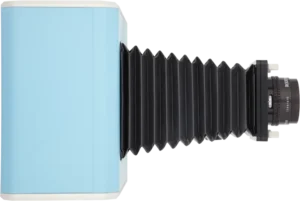
Apollo Camera – Current world’s leading infrared camera
The diagnostic phase of the Museum Ludwig project relied heavily on Infrared Reflectography (IRR) as the primary non-invasive method for looking beneath the visible paint layers. Using Opus Instruments camera, which has become the global “gold standard” for high-resolution IRR, researchers were able to visualize carbon-based preparatory materials, such as graphite, charcoal, or ink, that absorb infrared light, creating a sharp contrast against the reflective ground. The importance of this technique lies in its ability to reveal the underdrawing and pentimenti (compositional changes), providing a “technical signature” of the artist that stylistic analysis alone cannot capture.
While material analysis like carbon dating has been utilized since the 1940s, it was often challenged by the art market on the grounds that samples might have been taken from restored areas. It was only with the advent of high-resolution digital imaging systems like Opus Instruments cameras, and the systematic methodology adopted by the Museum Ludwig starting in 2011, that a truly integrated forensic approach became possible. IRR served as a vital guide for scientific integration, allowing conservators to decide with surgical precision where to collect micro-samples for pigment analysis and C14 dating, ensuring the material analyzed was original to the primary paint layer and not a later addition.
The high-resolution findings captured by Opus Infrared Reflectography cameras provided the definitive evidence required to either authenticate or de-attribute key works in the collection:
In one of the most remarkable forensic discoveries, Opus camera scans revealed that the abstract composition was not painted on a blank support, but over an 1894 photogravure print of a 19th-century genre painting by Ludwig Knaus. Furthermore, the underdrawing was not executed in pencil, as was Lissitzky’s habit, but was scratched into the ground using a compass point. These anomalies definitively established the work as an inauthentic forgery.

Left: Visible light reading
Right: The art print beneath the paint layer in the infrared reflectogram
IRR was used to confirm authenticity by making visible a brush underdrawing so prominent it bled through to the reverse of the canvas. This evidence allowed researchers to link the work directly to Popova’s preliminary study on paper, proving the transfer of the sketch to the final support. The technical construction and documented provenance confirmed the work as an original masterpiece by the artist.
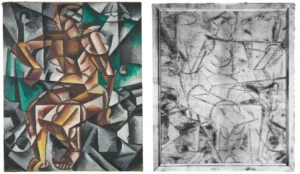
Left: Visible light reading
Right: Infrared Imaging results
Opus camera captured a detailed pencil underdrawing. Comparing this loose yet precise graphite work with the artist’s known drawings on paper provided a rare and clear insight into her authentic working methods, which usually involved charcoal underdrawings that are often invisible to standard IR techniques. The imaging findings, consistent with her recognized technique, confirmed the painting’s status as an authentic work.

Left: Visible light reading
Right: Infrared Imaging results
IRR revealed a continuous contour line defining the size and position of the central rectangle, which, alongside a reused strainer bar from an 1863 portrait, highlighted the complexity of the work’s construction. While the complex build initially suggested authenticity, a final assessment regarding its status remains inconclusive, and it continues to be classified as a disputed attribution.
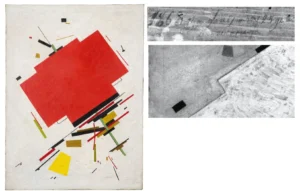
Left: Visible light reading
Right top: Cyrillic inscription on the upper stretcher bar
Right bottom: Outline of the central geometric element
Reflectography of the upper half of the painting showed distinct underdrawing lines. Diagnostic imaging also revealed that the central red square was originally wider and that the black lines were initially planned in different positions. However, carbon dating (C14) of the canvas fibers placed their growth in the 1960s, years after the artist’s death, proving the work to be an inauthentic forgery.
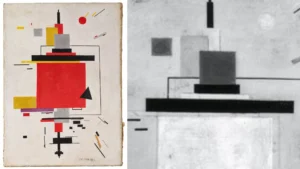
Left: Visible light reading
Right: Upper half of the painting, showing visible underdrawing lines
The reflectogram captured a rapid and loose application of paint in the light-gray background, which was deemed uncharacteristic of the artist’s precise style. This, combined with the discovery of synthetic polyamide fibers in the brush hairs embedded in the paint, invalidated the attribution, and proved the work to be a later forgery.
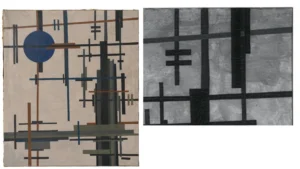
Left: Visible light reading
Right: Infrared reflectogram of the rapid paint application
IRR scans of the shoulder area revealed clear underdrawing lines, demonstrating how the artist precisely planned the geometric surfaces of the figure and the background. The spontaneous and skilled handling of materials revealed by the technology confirmed the work as an original by the artist.
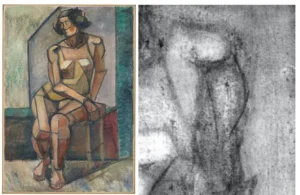
Left: Visible light reading
Right: Infrared reflectogram of a detail of the shoulder, with
clearly visible underdrawing lines
Opus imaging documented the preparatory lines of the geometric composition, likely executed with a pencil and ruler. A pinhole in the center also indicated the use of a compass to define circular forms. The use of an unusual support (a portfolio cover) and its status as an imitation of a known original in Moscow led researchers to reclassify the work as inauthentic.
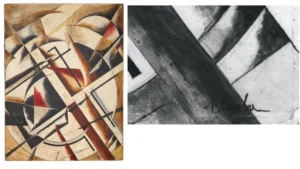
Left: Visible light reading
Right: Infrared reflectogram of the underdrawing lines
The success of the “Russian Avant-Garde at the Museum Ludwig” project is a testament to the power of global collaboration and interdisciplinary science. Bringing together experts from the Museum Ludwig, the Art Institute of Chicago (led by Maria Kokkori), the Russian Avant-garde Research Project (RARP), and technical specialists from the Restaurierungszentrum Düsseldorf, the project transcended borders to solve some of the most complex attribution challenges in modern art.
Over the course of ten years, 54 works from the Ludwig Collection were subjected to a rigorous forensic methodology. By integrating high-resolution Infrared Reflectography (IRR) via Opus camera with X-radiography, Carbon-14 dating, and Raman spectroscopy, the team achieved its primary goal: to move authentication beyond subjective stylistic opinion and toward scientific transparency. Opus Instruments is proud to have been a central part of this process, providing the diagnostic clarity required to establish a reliable “technical matrix” of pigments and underdrawings that now serves as a global benchmark for future research.
The impact on the art market has been profound. By publicly “cleaning house” and reclassifying inauthentic works, the Museum Ludwig has set a bold precedent for institutional honesty. This transparent approach actively combats the forgery industry that has thrived for decades on the “shadows of the Iron Curtain” and the lack of archival access.
For institutions, the value of material evidence cannot be overstated, particularly in legal and ethical contexts. Forensic data captured by Opus camera provides the “waterlight” proof necessary for criminal proceedings. The project’s findings were directly relevant to the landmark case of dealer Itzhak Zarug, who was convicted of fraud in 2018 for providing fictitious provenances for forgeries that had infiltrated major collections.
Ultimately, this project highlights the essential duty of museums to act as repositories of knowledge and stewards of cultural integrity. As technology continues to evolve, Opus current model, the Apollo camera remains an indispensable tool for curatorial teams worldwide, ensuring that the “aura of the original” is supported by undeniable material truth. By seeing the “imperceptible,” we ensure that art history remains an accurate record of human creativity.